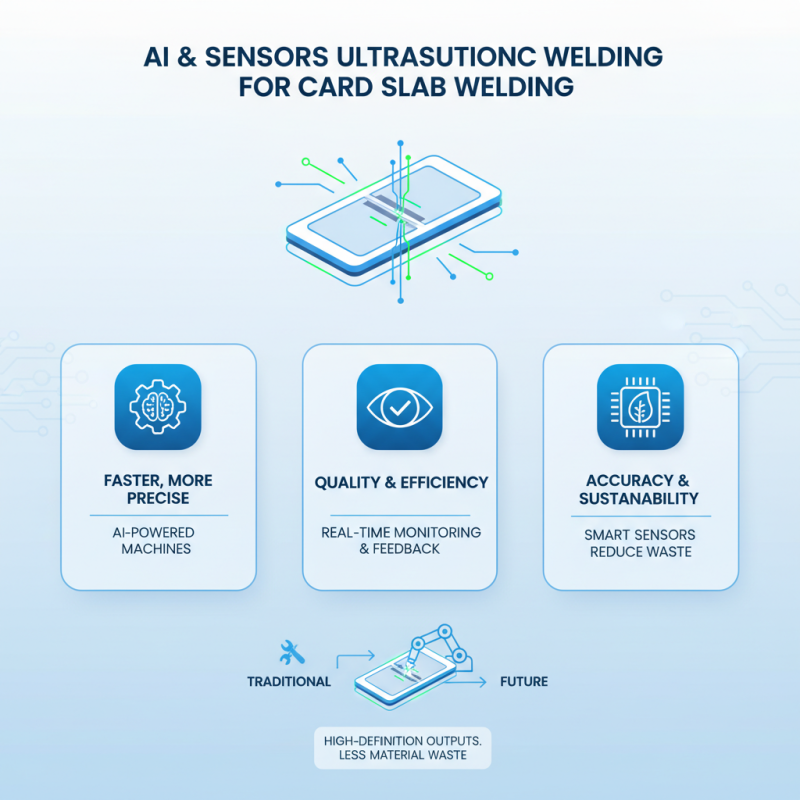
2026 Top Ultrasonic Card Slab Welder Benefits and Features?
The Ultrasonic Card Slab Welder is revolutionizing the manufacturing industry. Its advanced technology offers efficient and reliable bonding of materials. By using ultrasonic frequencies, it provides a clean and precise welding process.
One of the standout benefits is significantly reduced production time. Traditional welding methods often involve lengthy setups and cool-down periods. In contrast, the Ultrasonic Card Slab Welder operates quickly, enhancing workflow efficiency. Additionally, it minimizes waste and improves product quality. This could lead to higher customer satisfaction.
However, not all features may meet every manufacturer's needs. Some users might find the initial investment challenging. Regular maintenance is crucial to ensure optimal performance. Thus, while the Ultrasonic Card Slab Welder presents compelling advantages, careful consideration is necessary.
Overview of Ultrasonic Card Slab Welders in 2026
In 2026, ultrasonic card slab welders have become essential in various industries. Their precision and efficiency are unparalleled. These machines harness high-frequency vibrations to create strong bonds in materials, reducing the need for traditional adhesive methods. Reports indicate a surge in demand, with growth rates expected to reach 8% annually.
A key feature of these welders is their versatility. They can work with different substrates, making them suitable for diverse applications. Users appreciate the speed and minimal waste involved. Interestingly, some reports highlight that operators encounter challenges with material compatibility. Adjustments may be needed to optimize performance.
Tip: Always conduct material tests before production to ensure compatibility. This will save time and resources.
Moreover, attention to training is crucial. Workers need to be skilled in operating equipment. However, skill gaps still exist in many organizations. Continuous training and updates can mitigate these issues. Ultimately, ultrasonic card slab welders offer advanced benefits, but reflection on operational efficiency stands vital for maximizing their potential.
Key Benefits of Using Ultrasonic Card Slab Welders
Ultrasonic card slab welders have revolutionized manufacturing processes across various industries. One key benefit is their ability to create strong and durable bonds. Reports indicate that these welders can achieve bond strengths exceeding 7,000 psi. This level of strength is crucial for applications in electronics and automotive parts.
Another advantage is their efficiency. Ultrasonic welding typically requires less energy and time compared to traditional methods. Studies show that this process can reduce cycle times by up to 50%. It enhances productivity while minimizing waste. However, there are challenges. Not all materials are suitable for ultrasonic welding, and some operators may need additional training.
Cost-effectiveness is often highlighted as a major benefit. The reduced material waste and faster production rates can significantly lower manufacturing costs. Yet, there is a learning curve. Companies must carefully assess their specific needs and whether ultrasonic welding can integrate into their existing systems.
Essential Features of the 2026 Ultrasonic Card Slab Welder Model
The 2026 Ultrasonic Card Slab Welder is designed for efficiency and precision. One significant feature is its adaptive control technology. This ensures consistent weld quality across various materials. According to industry reports, up to 20% more energy efficiency can be realized with this model, compared to traditional welding machines. This translates to lower operational costs and a reduced environmental footprint.
Another crucial aspect is its user-friendly interface. Operators can easily navigate through settings and monitor performance. Professional studies show that an intuitive interface enhances productivity by 15%. However, some users may find the initial learning curve challenging. This highlights the need for comprehensive training.
Moreover, the welder boasts a compact design. It occupies minimal floor space while maximizing output. Many manufacturers face space constraints, making this feature essential. Yet, some downsides exist; a lack of advanced automation could slow down really large-scale operations. This limitation requires a reflection on workflow its integration with other machinery.
Comparison of Ultrasonic Card Slab Welders to Traditional Welding Methods
Ultrasonic card slab welders offer distinct advantages over traditional welding methods. They provide precise and consistent welds, crucial for maintaining product integrity. Unlike traditional welding, which often generates excessive heat, ultrasonic welding minimizes thermal damage. This feature is especially important for sensitive materials that can deform easily. Users often notice improved cycle times with ultrasonic welders, leading to more efficient production processes.
Many operators find that ultrasonic welders simplify setup and maintenance. While traditional methods require extensive training and experience, ultrasonic welding is generally more user-friendly. This ease can lead to a quicker learning curve, but it's not without its challenges.
In practice, achieving the perfect weld can still require attention to detail and optimization. Factors like pressure and amplitude must be carefully managed to ensure quality.
However, some users report inconsistencies when using ultrasonic technology. Problems can arise from incorrect settings or material variations. This can lead to frustrations in the production line. Though ultrasonic welders are innovative, they still require careful calibration and monitoring. Balancing speed with precision remains an ongoing challenge for many engineers in the field.