What is an Electric Ultrasonic Welder and How Does It Work?
The Electric Ultrasonic Welder has revolutionized industries focused on precision joining techniques. According to a report by Smith & Associates, the ultrasonic welding market is projected to grow by 8% annually. This growth indicates a rising demand for efficient and effective joining methods. Many industries, including automotive and electronics, increasingly rely on Electric Ultrasonic Welders for their cost-effectiveness and speed.
Dr. Emily Chen, a noted expert in ultrasonic technology, states, “Electric Ultrasonic Welders streamline production and enhance product quality.” Her insight reflects the current trends within manufacturing sectors. The significance of this technology lies in its ability to produce strong, reliable joints without the need for adhesives or additional materials. This not only saves costs but also reduces waste, addressing environmental concerns.
However, challenges exist in the adoption of Electric Ultrasonic Welders. Many companies face difficulties understanding the operational intricacies. A lack of skilled operators can hinder efficiency. Reflections on these challenges highlight the need for continued education and training in this field. Businesses must adapt to leverage the full potential of Electric Ultrasonic Welders, ensuring they remain competitive in an evolving market.
What is an Electric Ultrasonic Welder?
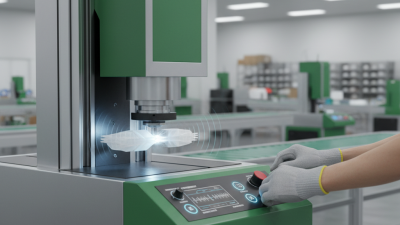
An electric ultrasonic welder is a device that uses high-frequency sound waves to join materials. This technology mainly applies to thermoplastics and certain metals. The welder generates ultrasonic vibrations through a transducer. These vibrations create localized heat at the interface of the materials to be joined. As a result, they melt and fuse together. This process is efficient and precise, making it popular in various industries, including automotive and medical.
According to industry studies, ultrasonic welding often reduces production time by up to 40%. This data underscores its effectiveness, showing how well it handles complex assemblies. However, it is crucial to ensure proper parameters. Incorrect settings can lead to weak welds. Even with advanced technology, users may encounter challenges. Each material has unique characteristics that impact the outcome.
Tips: Always test weld settings with sample materials. This simple step can help identify issues early. Monitoring the environment can also be beneficial, as temperature and humidity can affect welding performance. Regular maintenance of the ultrasonic welder is essential. It helps maintain reliable operation and consistent weld quality. Remember to keep records of welding parameters for future reference.
What is an Electric Ultrasonic Welder and How Does It Work?
| Feature |
Description |
| Working Principle |
Utilizes high-frequency ultrasonic sound waves to create localized melting of materials. |
| Applications |
Commonly used in industries like automotive, electronics, medical devices, and textiles. |
| Advantages |
Provides strong, precise welds with minimal thermal impact on surrounding materials. |
| Limitations |
Not suitable for all materials; best for thermoplastics and certain metals. |
| Machine Components |
Typically includes a generator, transducer, booster, and sonotrode. |
| Energy Consumption |
Generally low energy consumption relative to traditional welding methods. |
Components of Electric Ultrasonic Welders
Electric ultrasonic welders are essential in modern manufacturing. These devices utilize high-frequency ultrasonic vibrations to join materials. Their effectiveness largely depends on the components they comprise. Understanding these components sheds light on their functionality and applications.
The primary component of an ultrasonic welder is the generator, which converts electrical energy into ultrasonic energy. This energy is transferred to the transducer, where it converts electrical signals into mechanical vibrations. The booster amplifies these vibrations before they reach the sonotrode, which applies the vibrations to the workpieces. According to a recent industry report, ultrasonic welders can achieve bond strengths exceeding 10,000 psi, showcasing their efficiency in creating durable joints.
The process heavily relies on careful control and precision. Inadequate settings can lead to poor weld quality or material damage. For instance, incorrect amplitude settings can weaken the joint. Another notable component is the pneumatic system, which ensures consistent pressure during the welding process. Reports indicate that over 25% of manufacturers experience challenges related to pressure control. Understanding these intricacies is vital for optimizing performance and avoiding costly errors in production.
How Electric Ultrasonic Welding Works
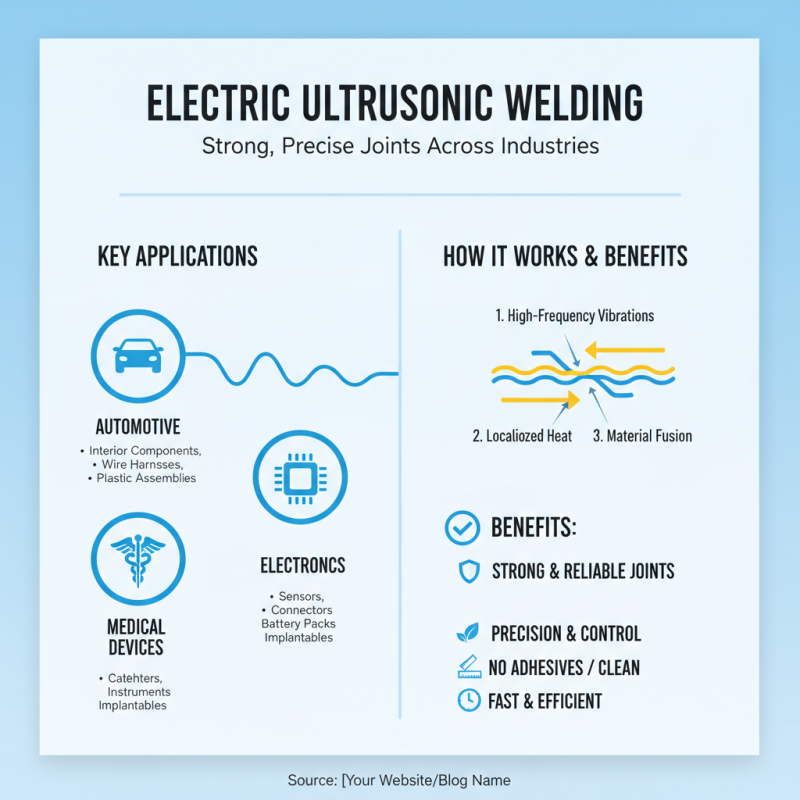
Electric ultrasonic welding is a modern technique used to join materials. It utilizes high-frequency ultrasonic vibrations to create heat. This heat is generated at the joint interface, allowing for effective bonding, particularly in thermoplastics and thin metals.
During the process, an ultrasonic transducer converts electrical energy into mechanical energy. The ultrasonic vibrations are then transmitted through a sonotrode, causing localized heating at the contact points. This innovative method is efficient and reduces the need for additional materials like adhesives.
**Tips:** Ensure the surfaces to be welded are clean and free from contaminants. This prepares the materials for optimal bonding. Monitoring the pressure applied during welding is crucial. Too much pressure can lead to material deformation, while too little may result in weak joints.
Another consideration is the frequency of the ultrasonic waves. Different materials may require adjustments to the frequency for the best results. Testing with sample pieces can help mitigate potential issues. Always be ready to adjust parameters for optimal performance; it can make a significant difference in the final product quality.
Ultrasonic Welding Process Overview
Applications of Electric Ultrasonic Welding
Electric ultrasonic welding finds applications across various industries, such as automotive, electronics, and medical devices. This method produces strong, precise joints by using high-frequency vibrations. These vibrations create localized heat at the material interface, joining them without the need for additional adhesives or heat sources.
In the automotive sector, ultrasonic welding is popular for assembling plastic components. It allows for quick production cycles and reduces material waste. In electronics, this method efficiently connects delicate wires and components, ensuring reliable connections. The medical industry benefits from ultrasonic welding in devices that require sterile and secure joints.
Tips: Always ensure proper settings for the specific materials being welded. Incorrect parameters could result in weak joints. Conduct regular maintenance to avoid equipment failures.
In applications that require cosmetic finishes, ultrasonic welding can be challenging. Often, the visible seams can affect the aesthetic appeal. It’s important to evaluate the trade-off between strength and appearance.
Advantages and Disadvantages of Electric Ultrasonic Welding
Electric ultrasonic welding offers notable advantages and some drawbacks.
One significant benefit is its efficiency. This method uses high-frequency sound waves to create heat and bond materials, resulting in quick processing times. As a result, it is ideal for industries that demand rapid production, such as automotive and electronics. The process is also clean, requiring minimal additional materials.
However, there are disadvantages. The equipment and setup can be expensive, which may deter smaller companies. Additionally, the process requires skilled operators for optimal performance. Improper handling may lead to weak joints or defects. Not every material is suitable for ultrasonic welding, which limits its applicability in some contexts.
Thus, while electric ultrasonic welding is a powerful technique, careful consideration is needed regarding its implementation.