How to Choose the Right Ultrasonic Welder Plastic for Your Needs?
Choosing the right Ultrasonic Welder Plastic can be a daunting task. Industry expert Dr. Emily Chen emphasizes, “Selecting the appropriate ultrasonic welder is crucial for achieving optimal results.” With various models available, it's essential to consider your specific needs.
When evaluating options, think about the materials you will weld. Different plastics require different ultrasonic frequencies for effective bonding. Additionally, consider the scale of your projects. A higher-capacity welder may be necessary for industrial applications, while smaller units suffice for hobbyists.
Keep in mind that not all welders deliver the same performance. Some may not perform well with certain plastics, leading to weak joints. Understanding your requirements and the welder's specifications helps in avoiding mistakes. Reflection on these factors can lead to better decisions in selecting an Ultrasonic Welder Plastic tailored to your needs.

Factors to Consider When Selecting an Ultrasonic Welder for Plastic
When selecting an ultrasonic welder for plastic, several factors merit consideration. Understanding your specific needs is vital. Start by evaluating the types of materials you will be working with. Different plastics require varied ultrasonic frequencies and amplitudes for effective bonding. Always check the compatibility of the welder with your preferred plastic types.
Power levels are crucial. A unit with adjustable power settings can provide better flexibility for different projects. Consider the size and weight of the welder, too. A portable model is beneficial for smaller workshops or projects. However, larger industrial units can offer greater durability and efficiency.
**Tip**: Conduct a trial run if possible. This allows firsthand experience with how the welder works with your materials.
Cooling systems should not be overlooked. They affect the welder's performance during extended use. Look for models with reliable cooling mechanisms to prevent overheating.
**Tip**: Read user reviews to gather insights about reliability and performance in real-world conditions.
Ultimately, the right choice will reflect your specific requirements and workflow. Investing time in research will yield a better outcome for your projects.
Types of Ultrasonic Welders Available and Their Applications
When selecting an ultrasonic welder for plastic, it's important to consider the various types available and their specific applications. The most common types include hand-held, table-top, and automated systems. Hand-held welders are portable and ideal for small projects or repairs. They provide flexibility but may require more skill to operate effectively.
Table-top models are versatile, suitable for medium-sized tasks. These machines can handle various welding applications, making them excellent for small manufacturing settings. Automated systems are designed for high-volume production. They offer consistency and speed, but they require a larger investment.
Choosing the right type hinges on your production needs. Consider factors like the materials you will work with, production volume, and budget. Each type has its pros and cons. For instance, while automated systems save time, they may lack the adaptability of hand-held options. Reflect on your goals and the demands of your projects when making a decision.
How to Choose the Right Ultrasonic Welder Plastic for Your Needs?
| Type of Ultrasonic Welder |
Material Compatibility |
Typical Applications |
Advantages |
| Handheld Ultrasonic Welder |
Thermoplastics (PP, PE, PVC) |
Repair work, small batch production |
Portability, ease of use |
| Automated Ultrasonic Welder |
Various Plastics (PS, ABS, PC) |
Mass production, assembly lines |
High efficiency, consistency |
| Tabletop Ultrasonic Welder |
Thermoplastics (Nylon, PET) |
Small to medium production runs |
Space-saving, versatile |
| Continuous Ultrasonic Welder |
Flexible and Rigid Plastics |
Continuous operation, inline systems |
High throughput, reduced cycle times |
Understanding the Technical Specifications of Ultrasonic Welders
When selecting an ultrasonic welder for plastic, understanding the
technical specifications is crucial. Key specifications include
frequency, power output, and weld time. The frequency typically
ranges from 20 kHz to 40 kHz.
Higher frequencies are suitable for thinner materials,
while lower frequencies work well with thicker plastics.
Power output varies between models. Generally, a welder with 1000 to 3000 watts is adequate
for most applications. Evaluate the thickness and type of plastic you will be welding. If the
materials are diverse, consider a model that allows adjustable power settings
for versatility.
Tips: Always check the duty cycle of the welder.
A longer duty cycle means the machine can work for extended periods without overheating. Verify the user manual
for specifications before making a purchase.
Another aspect to consider is the size and shape of the welding tip. Different shapes affect
the weld's effectiveness. Experimenting with various tips can lead to better results, but it may also require
practice. Ultimately, understand your specific needs to make informed decisions.
Cost vs. Performance: Finding the Right Fit for Your Budget
Choosing the right ultrasonic welder for plastic involves balancing cost and performance. Many users face the dilemma of selecting a model that meets their needs without overspending. It's essential to assess both short-term and long-term costs. A lower upfront cost may seem appealing, but hidden costs for maintenance and supplies can undermine savings.
Performance is linked to the types of materials you work with. When welding different plastics, understanding their properties can affect the outcome. Investing in a welder with adjustable settings can provide flexibility for various projects. This adaptability is crucial, especially if your production volume fluctuates.
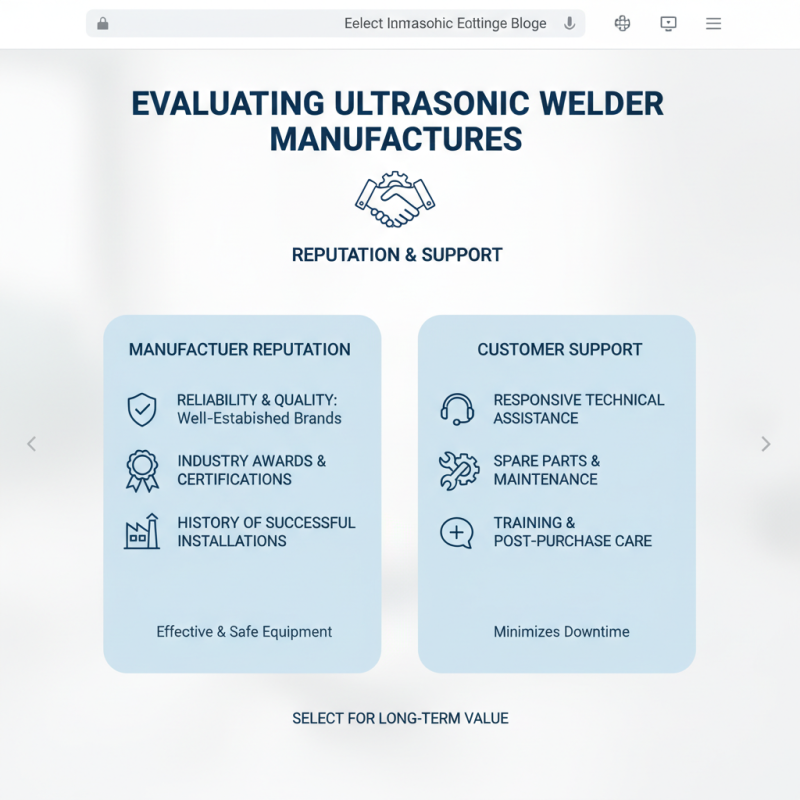
Consider the warranty and customer support available. A reliable manufacturer often provides better service. However, some users report frustration with unresponsive support teams. Researching user reviews can provide insight into these aspects. It’s a good reminder that not all experiences are positive, and careful consideration is key.
Cost vs. Performance of Ultrasonic Welders
This chart compares the cost and performance of ultrasonic welders across three categories: low-end, mid-range, and high-end. The cost is measured in USD, while performance is rated on a scale of 1 to 10.